

The Centre-Right Moderate is a Dying Breed
Kooyong, Melbourne, Australia and the Death of a Dynasty


Kooyong is a wealthy suburb located in eastern Melbourne, Australia. Most of its inhabitants have a higher income than the national average, with 59.3% of them being professionals and managers compared to 37.7% of Australia’s population. Since the country’s first general elections in 1901, Kooyong’s federal division has been held by the conservative Liberal Party of Australia (LP) and its ideological predecessors. It was even the former seat of Robert Menzies, a Liberal who was Australia’s longest-serving Prime Minister. In essence, Kooyong was the safest of safe seats held by one party for an astonishing 70 years.
However, the 2022 Australian federal election was a watershed moment. For the first time, the Liberal Party lost Kooyong. Yet, this defeat was not to the main opposition Labour Party, but to a local independent. This came from a surge of support for socially liberal so-called Teals, who took former strongholds of the LP, including Kooyong. Even the heir presumptive to the party, Joshua Frydenberg, was not spared. Despite being a member of the LP’s centre-right mainstream, Frydenberg campaigned on a very centrist liberal message, but was still encumbered by a resonating grassroots campaign. He lost, along with his successor, in the 2025 federal election. This case illustrates the distinct decline of the moderate centre-right, a global trend that has been evident over the past few decades and appears to be reaching its culmination.
When examining individual countries, this narrative starts to become clearer. The Christian Democratic Union (CDU), once a dominant force in the German political landscape, is now a shadow of its former self.. France’s Gaullists are being both cannibalised from within and consumed by the centre and far-right. Forza Italia is merely a junior party in a populist right-wing government. And the UK Conservative Party is sliding evermore into obscurity in exchange for the rapid rise of Reform. In other Anglophone countries, Canada’s Conservative Party has moved ever rightwards, and the Republican Party has been hijacked by the far-right. Except in Ireland, the mainstream centre-right has seen its support dwindle. So, where has the traditional centre-right gone?
The simple answer is that the centre-right has been forced to evolve. These parties have assumed different identities to redress electoral failure. Either more right-wing factions have exiled it, or it has consciously edged closer to the populist right for political survival. However, in recent memory, centre-right parties were fashioned in a different mould.
Like the liberal moderates that formerly appealed to Kooyong’s middle classes, centre-right parties stood, at least outwardly, for social stability, free but fair markets, and the sacred value of traditional institutions. As the late Australian political scientist James Jupp outlined, conservative parties functioned by adjusting and balancing interests to preserve social harmony within the framework of the established institutional order. This careful balancing act was particularly pronounced among those directly influenced by a liberal tradition. Their social base consisted of the ‘Silent Majority’ of ordinary working households, ranging from the professional-managerial class to non-union-aligned blue-collar workers. Post-war centre-right parties were successful because they did not target the urban elites, but rather a broad church of everyone who was not tied to organised labour.
If you peel back the layers, however, this collapse of the centre-right is centred on global sociological and economic trends that were, ironically enough, self-inflicted. These unintended trends highlight how the centre-right overlooked that their radical liberalisation of the economy would bring about side effects that were less than desired.
On the 25th anniversary of the release of The End of History and the Last Man, Francis Fukuyama reaffirmed that his book was about a triumphalist eschatology of liberal democracy just as much as it was about the potential for its political decay. The biggest problem for liberal democracy was not that there is a better mode; it was the inability of political elites to accommodate the changing social structure caused by post-industrialisation. The problem is not ideological, but rather a “failure to provide the substance of what people want from the government: personal security, shared economic growth and the basic public services …” This gets to the heart of why moderate forces have seen support wane lately: they have not fully grasped the consequences of the changes they have implemented.
It was here that voters have been abandoned by their conventional political homes over the past 40 years. The once reliably centre-right middle-class voter, living in the suburbs and working in service sector roles, has become more explicitly socially liberal.
Middle-class support was once a certainty for the centre-right, who still saw mass appeal when it forged an indissoluble link between populist conservatism and radical and “bitter-tasting” free-market capitalism. Middle-class voters were initially drawn to this fashionable ideological realignment due to prevailing discontent with the counter-culture movement and the chronic inflation and unemployment of the 1970s. Margaret Thatcher's now (in)famous quote from 1987, “There is no such thing as society,” is often cited and misrepresented. What she implied is that so-called “society” is woven into a “living tapestry of men and women and people”.
This so-called individualisation of societal responsibility is not entirely antithetical to the centre-right tradition. Still, it marks a departure from the post-war social market economy and Christian social teaching. It was during the honeymoon of the “centre-right” during the 1980s that their enthusiastic embrace of neoliberalism and economic globalisation would ultimately mark a gradual downturn.
The collapse of the Soviet Union posed a significant challenge for centre-right parties, as voters disentangled themselves from their associations with the centre-left and Soviet state socialism. Furthermore, with the entrenchment of once-radical neoliberalism in mainstream economic policy, “There [was] No Alternative (TINA)” for the right but to follow suit inflexibly. The right’s scepticism for the advance of liberal tolerance was placed in the foray of the newfound cosmopolitan optimism of the 90s. Conservative parties lacked a new, innovative policy framework to counter an emerging generation of popular and moderate centre-left leaders who now led less divided and stubbornly doctrinaire parties. The global centre-left managed to disassociate neoclassical economics from its increasingly toxic social conservative roots by projecting a kind and compassionate face that recognised growing political pressure for more generous social compensation.
It was in the post-2008 recession environment that the depleted centre-right was forced to ingratiate itself beyond its traditional social base and move towards the once despised forces of unionised labour.
Conservatives have tried to outrun the centre-left on this issue by highlighting globalisation’s more tangible social detriments – such as industrial offshoring, declining union membership, and the either perceived or very real negative impacts of immigration – from its less visible economic benefits. If 2008 pierced the free-market consensus, COVID-19 laid it bare. The right attempted to go further with a more statist and fiscally loose response to the pandemic, partly to appeal to these older populist voters. Boris Johnson clearly repurposed Thatcher’s quote in a video message during the pandemic:
“One thing I think the coronavirus crisis has already proved is that there really is such a thing as society.”
Meanwhile, the decline of organised religion and political secularisation has plagued the right. Northeast White Anglo-Saxon Protestants and middle-class Anglican conformists made up the Blue Wall of the Republican and Conservative Party, respectively. These moderate religious constituents were the inheritors of the classic aphorism, “An Englishman’s home is his castle”, who were woven into “the great fabric of English liberty”. These suburban middle-class voters have gradually become less religious and/or disassociated their values from conservatism.
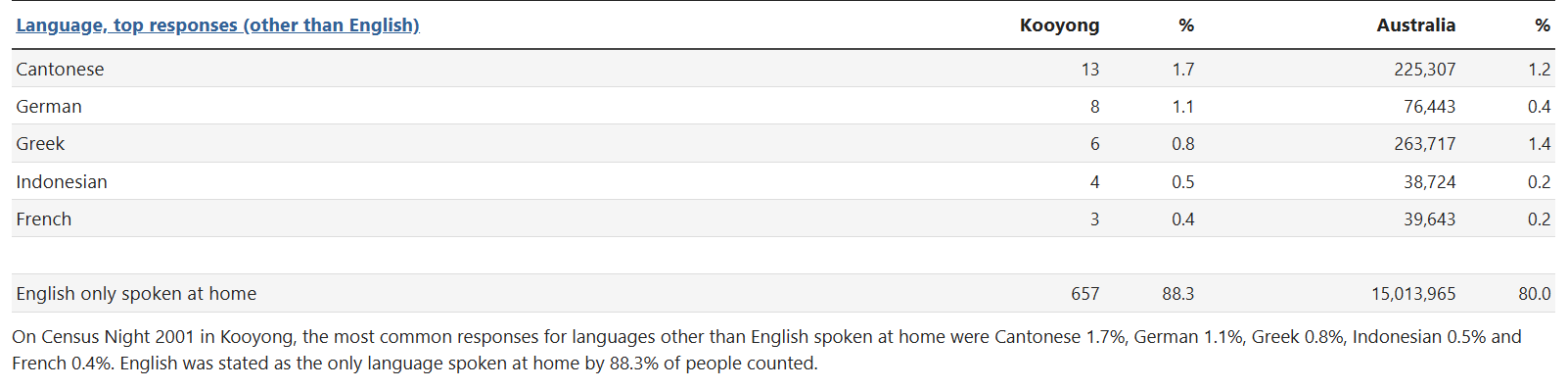
This trend is evident, for instance, in both Kooyong, as compared to the national census data.
2001:

2021:

The right initially underestimated the disruptive effects of cosmopolitan globalisation, from immigration and diversity to intersectionality, which have caused fragmentation or political displacement. Suburban whites once fueled the “backlash” to Civil Rights, fearing “white displacement”; yet, suburbs have since diversified—and many white working men have grown more at ease in multiethnic, cosmopolitan settings. Educated immigrants have integrated into the middle class, while white-collar whites have embraced globalised culture. Suburban women, meanwhile, have drifted from the centre-right, aligning with cultural liberalism instead and vote accordingly, only when inflation is not a concern.
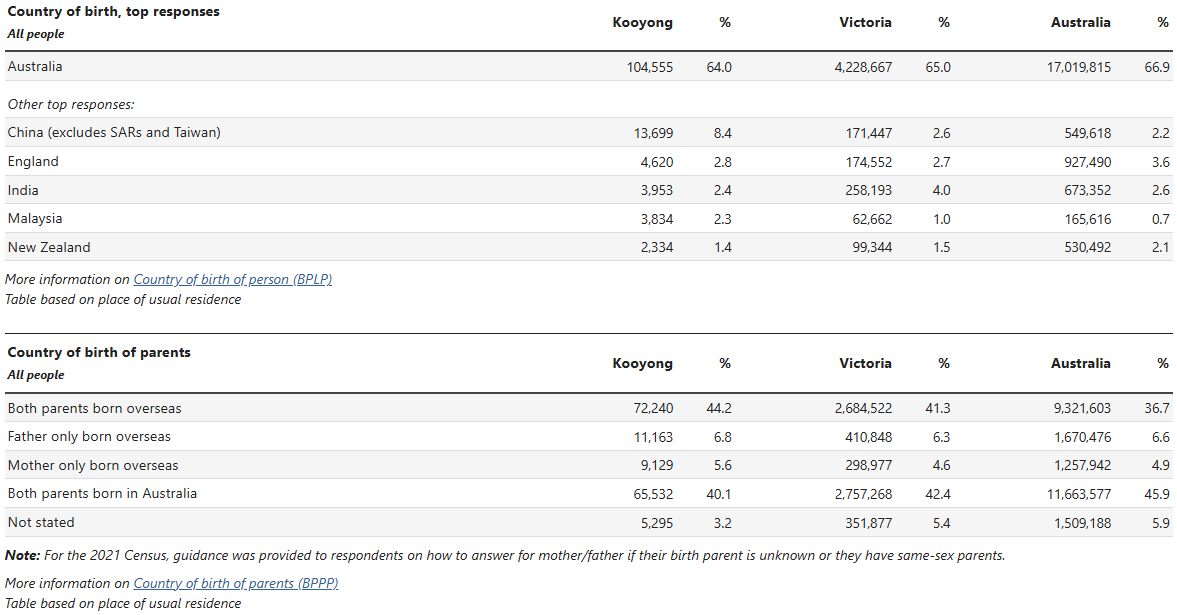
Census data for Kooyong reflects these demographic trends:
2001:

2021:
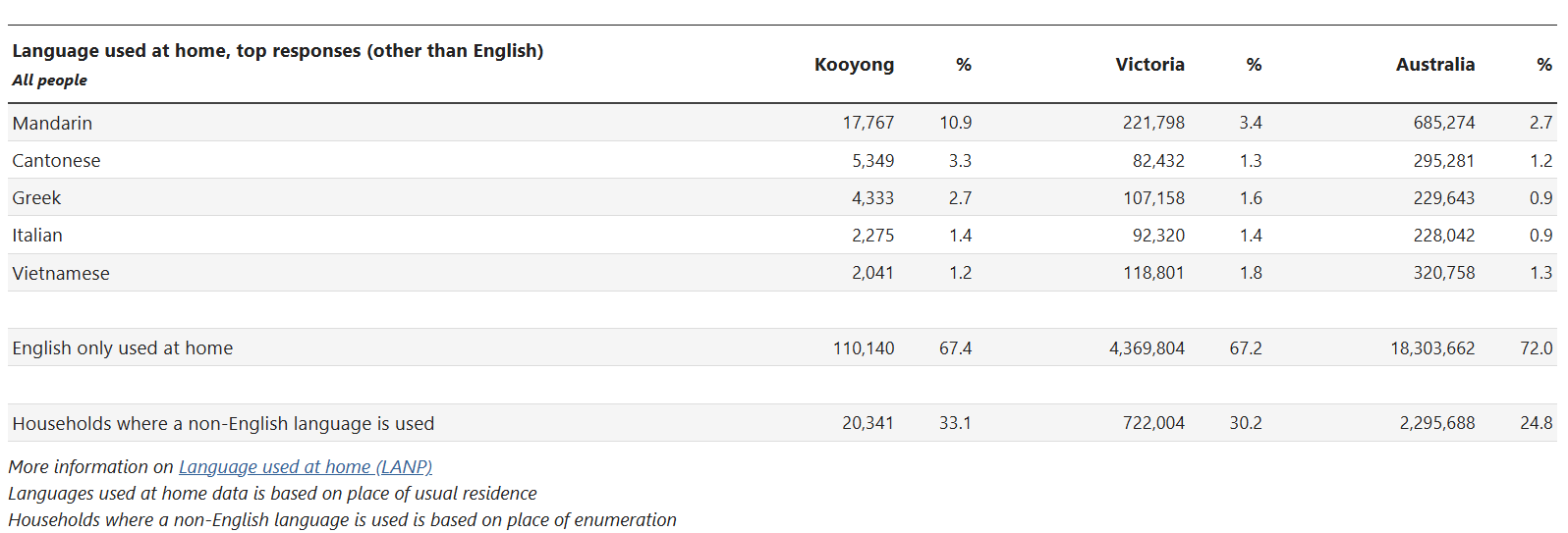
The trend is working in both directions, with the centre-right converging on economic policy and the centre-left converging on social policy, primarily on issues such as immigration and transgender rights.
Years of abrasive “Culture Wars” – as precipitated by the American Christian Right – and now the “anti-Woke” political strategy have tended to alienate moderate voters towards more liberal but still centrist options, such as the US Democrats or the UK’s Liberal Democrats. Meanwhile, displacement caused by globalisation has seen older working-class voters shifting from being the bedrock of the centre-left, through organised labour, towards the centre-right.
This is where Australia fits into this. With the international toxicity of MAGA-inspired movements, the traditional social bases of the now firmly right-wing Liberal Party were divided and conquered by liberal Independents and the Labor Party in both the 2022 and 2025 federal elections, with their leader, Peter Dutton, also losing his seat. The Australian Liberals had their supposedly solid economic credentials exposed by running an absurdly high deficit, which Labour turned into a surplus within two years. This echoes the perception of the now economically inept UK Conservative Party, with the consequences of austerity, Liz Truss’s mini-budget, and, to a lesser extent, Brexit. Australian Labor’s economic rationalism, combined with an alluring social progressivism, captured young urban professionals, civil servants and others who were repulsed by the Liberals' rightward turn.
A similar phenomenon occurred in Canada, although with less fanfare. Mark Carney already led a big-tent centrist coalition. Still, his name represented economic competence and commanded respect against an obnoxious populist message touted by the Conservative candidate Pierre Pollievere, who unexpectedly lost in his once-reliable riding of Carleton.
This claim of centre-right decline does not mean the decline of centre-right parties as a whole. Some of those parties have been doing quite well, whether regionally or nationally, especially compared to the centre-left. The Victorian branch of the Liberals still decisively held Malvern, the state division of Kooyong, in the 2022 Victoria state elections. Still, the political affiliation of the elusive middle classes moved into contested territory during a process that began in the 1980s. The centre-right’s recent shift to right-wing populism needs to be carefully balanced to avoid alienating the moderate centre or the extreme right-wing, walking a very fine line between narrowly casting a vote for small, sometimes extreme bases while appealing to an ever-bigger tent.
Sources
Books & chapters
Crewe, I., ‘Has the Electorate Become Thatcherite?’ in Skidelsky, R. (ed.), Thatcherism (1988), p. 32.
Davies, A., Jackson, B. and Sutcliffe-Braithwaite, F. (eds.), The Neo-Liberal Age? Britain Since the 1970s (2021), p. 85.
Shaw, E., Losing Labour’s Soul? New Labour and the Blair Government, 1997–2007 (2007; repr. 2012), p. 11.
Websites, Videos & Online articles
Australian Bureau of Statistics, Census QuickStats: 2001 SSC21936 (2001), https://www.abs.gov.au/census/find-census-data/quickstats/2001/SSC21936 [accessed 7 September 2025].
Australian Bureau of Statistics, Census QuickStats: 2021 CED226 (2021), https://www.abs.gov.au/census/find-census-data/quickstats/2021/CED226 [accessed 7 September 2025].
The Conversation, ‘Why “There’s No Such Thing as Society” Should Not Be Regarded with Moral Revulsion’ (2020), https://theconversation.com/why-theres-no-such-thing-as-society-should-not-be-regarded-with-moral-revulsion-136008 [accessed 7 September 2025].
The Guardian, ‘20,000 NHS Staff Return to Service, Johnson Says from Coronavirus Isolation’ (29 March 2020), https://www.theguardian.com/politics/2020/mar/29/20000-nhs-staff-return-to-service-johnson-says-from-coronavirus-isolation [accessed 7 September 2025].
Liberal Party of Australia, The Liberal Party of Australia — An Exorcism, YouTube, 6 June 2025
[accessed 3rd September 2025].
New Statesman, ‘Is the Centre Right Doomed?’ (2 June 2025), https://www.newstatesman.com/comment/2025/06/is-centre-right-doomed-conservatism [accessed 7 September 2025].
New Statesman, ‘The Strange Death of the Centre Right’ (22 February 2023), https://www.newstatesman.com/international-politics/2023/02/strange-death-centre-right-moderate-conservatism [accessed 7 September 2025].
Observer, ‘The Party is Over: The Tory Slump is Part of a Global Conservative Comedown’ (2025), https://observer.co.uk/news/politics/article/the-party-is-over-the-tory-slump-is-part-of-a-global-conservative-comedown [accessed 7 September 2025].
UnHerd, ‘The Death of the Centre Right’ (May 2025), https://unherd.com/2025/05/the-death-of-the-centre-right/ [accessed 7 September 2025].
Wall Street Journal, ‘At the End of History, Still Stands Democracy’ (6 June 2014), https://www.wsj.com/articles/at-the-end-of-history-still-stands-democracy-1402080661 [accessed 7 September 2025].
Word Histories, ‘An Englishman’s Home is his Castle (Origin)’ (26 July 2017), https://wordhistories.net/2017/07/26/englishmans-home-castle-origin/ [accessed 7 September 2025].